Cutting Corners Design is now called Bags and Seams Design!

Author
Sarah is a successful pattern designer for bags, the founder of Bags and Seams Design, and a BERNINA instructor. With great passion, she helps beginners discover their enthusiasm for sewing bags. In her high-quality courses, she teaches the necessary skills step by step and ensures motivating sewing experiences with tangible results.
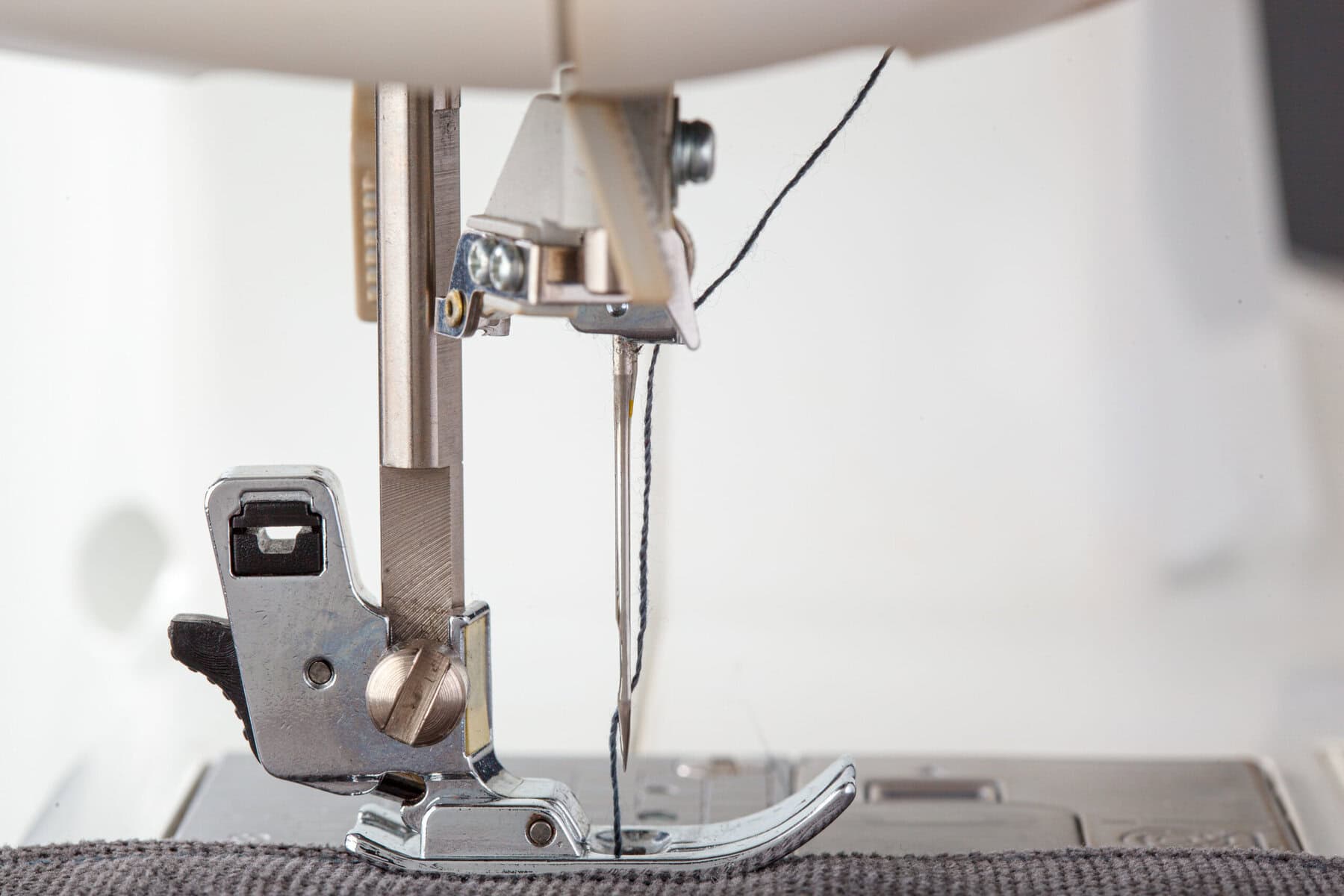
Choosing the right sewing machine needle depends not only on the fabric, but also on the thread, the interfacing, and the number of layers of material. That’s why understanding needles is so important when sewing.
For simple bags made of cotton fabric, a size 80 all-purpose needle is often sufficient. For canvas, denim, webbing, and thicker sections, a size 90 or 100 denim needle is usually more suitable. A Microtex needle can be useful for tightly woven, coated, or smooth materials, as well as for precise quilting stitches. You should use leather needles primarily for genuine leather or very sturdy faux leather.
The most important rule is: The sturdier the material, the thicker the thread, and the more layers you’re sewing together, the stronger the needle generally needs to be.
Since this is one of the most important foundations for creating beautiful seams on your bag, in this blog post we’ll go over all the information you need to sew your bag.
When sewing bags, a needle often has to do more than it does in simple sewing projects. It doesn’t just pierce a single layer of cotton fabric. Often, there are several layers of material on top of each other, for example:
Particularly thick areas can quickly form at handles, corners, zipper ends, and pocket seams.
If the needle is too fine, it may bend or break. If the needle tip is unsuitable for the material, it can result in missed stitches, broken threads, or visible damage to the material. On the other hand, a needle that is too large can leave unnecessarily large needle holes.
The right needle improves:
For most bag projects, you don’t need twenty different types of needles. A small selection is enough to cover many materials:
1. Universal needle,
2. Microtex needle,
3. Topstitch needle.
Which one is correct always depends on the complete combination of materials. It’s not just the outer fabric that matters. The lining, batting, thread, and the thickest part of the project must also be taken into account.
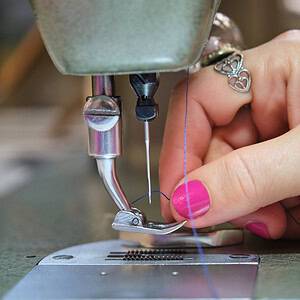
Be sure to thread your needle correctly as well
Needle sizes are often indicated by two numbers, such as 90/14 or 100/16.
The first number corresponds to the European sizing system. It indicates the diameter of the needle shaft in hundredths of a millimeter. A size 90 needle therefore has a shaft diameter of approximately 0.90 millimeters. The second number indicates the corresponding American size.
Typical sizes for bag projects are:
A higher number indicates a thicker needle. However, it does not automatically mean that the needle is suitable for every solid material. In addition to thickness, the needle type must also be compatible with the surface and structure of the material.
The universal needle is the standard needle for many common sewing tasks. It is suitable for a wide variety of woven fabrics and simple bag projects.
Suitable for
For a simple bag project made from regular woven cotton fabric, a size 80 all-purpose needle is usually a good place to start. A size 90 all-purpose needle can work if the fabric is slightly sturdier or if you’re adding a light interfacing.
The universal needle is versatile, but it isn’t the best solution for every combination of materials. For more challenging fabric combinations, a specialty needle often produces a neater result.
Be sure to always test the actual combination of materials. A lightweight canvas with a thin lining may only require a size 90 needle. Four layers of canvas, interfacing, and webbing, on the other hand, may require a size 100 needle.
The Microtex needle has a particularly slender and pointed tip. For this reason, it is also known as a Sharp needle.
It can produce a clean stitch pattern on tightly woven, smooth, or coated fabrics, as well as with precise quilting stitches. The manufacturer recommends it for coated fabrics, synthetic leather films, oilcloth, and soft synthetic leather, among other materials.
Suitable for
Available sizes
Depending on the material, the following sizes are often used:
Don’t automatically use the largest needle available. On faux leather, vinyl, and coated fabrics, needle holes remain permanently visible. An unnecessarily large needle can therefore damage the material.
The topstitch needle is designed for visible topstitching and for sewing with thicker or more delicate threads.
It has a longer or larger eye than a standard all-purpose needle. This makes it easier for thicker thread to pass through the eye.
Suitable for
However, a topstitch needle doesn’t solve every problem with thick thread. Thread tension, stitch length, the bobbin thread, and the machine’s performance must also be suited to the combination.
To create clearly visible topstitching, you can also try using a slightly longer stitch length, such as 3 to 3.5 millimeters. The optimal setting depends on the machine, fabric, and thread.
For a European needle size of 80, the diameter of the needle shaft is approximately 0.80 millimeters. A size 100 needle is, accordingly, approximately 1 millimeter thick. The size number is therefore not chosen arbitrarily.
The needle size depends on three factors:
1. the material,
2. the number of layers,
3. the thickness of the yarn.
As a general rule:
The needle size must be appropriate for both the fabric and the thread thickness. The finer the fabric and thread, the finer the needle should be.
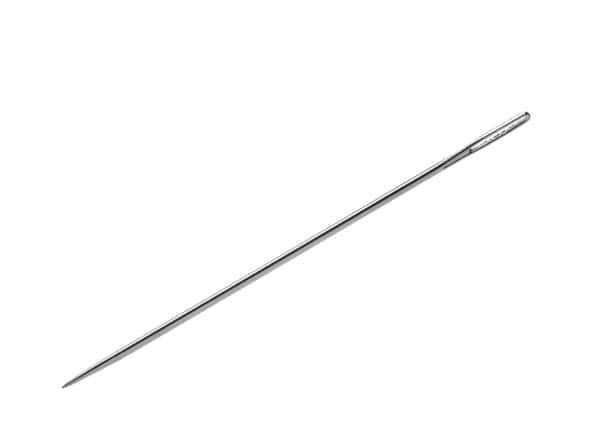
A sewing machine needle consists of the shank, the shaft, the groove, the hollow groove, the eye, and the point.
Many modern household sewing machines use the 130/705 H needle system. This system features a flat shank, which must be oriented in the specified direction when inserted into the machine.
Be sure to check the instruction manual for your sewing machine anyway. Older machines, overlock machines, coverlock machines, and industrial machines in particular may require different needle systems.
Choosing the right type of needle alone is not enough if the needle system does not fit the machine.
An incorrectly inserted needle can also cause skipped stitches and thread problems.
Here’s what to do:
1. Turn off the sewing machine.
2. Raise the needle bar to its highest position.
3. Loosen the needle screw.
4. Remove the old needle by pulling it downward.
5. Insert the new needle all the way to the stop, following the machine’s instructions.
6. Carefully tighten the needle screw.
7. Rethread the machine.
8. Slowly turn the handwheel once by hand.
On most household machines, the flat side of the piston faces backward. However, there are exceptions. Therefore, always refer to your machine’s instruction manual.
Interlining and reinforcements give a bag its shape, structure, and stability. Without reinforcement, bags made of thin fabrics often appear flimsy or collapse.
The type of lining you need depends on the type of bag and the outer fabric used.
A small zippered pouch usually requires only light to moderate reinforcement. A shopping bag often needs more stability, especially at the bottom and where the handles attach. For backpacks or weekend bags, sturdier linings, foam batting, or additional bottom inserts are often used.
Keep the following basic rule in mind: The thinner the fabric and the larger the bag, the more important it is to use proper reinforcement.
Always test the combination on a scrap of fabric. Iron a small piece of the interfacing onto the fabric and let it cool completely. Then you can determine whether the result is soft, retains its shape, or is perhaps too stiff.
A sewing machine needle is a wear-and-tear part. Even if it hasn’t broken yet, its tip may already be dull or the shaft may be slightly bent.
As a general guideline, SCHMETZ recommends changing the needle after about eight hours of sewing or at the start of a new project. Depending on the material and the strain on the needle, it may be necessary to change it sooner.
Change the needle immediately if:
Damaged or worn needles can cause, among other things, frayed threads, skipped stitches, puckered fabric, and noticeable noises.
Mistake 1: Using a needle that’s too fine for thick layers
A size 80 universal needle may be ideal for two layers of cotton. However, it may be too fine for multiple layers of canvas, interfacing, and webbing. The needle could bend, hit the stitch plate, or break.
Better: For tightly woven fabrics and thick seams, use a suitable jeans needle in size 90 or 100.
Mistake 2: Always use the thickest needle
A very thick needle isn’t necessarily better. It creates larger holes and can visibly damage delicate fabrics or coatings.
Better: Use the finest needle that can still reliably sew through the fabric and thread.
Mistake 3: Using a leather needle for every type of faux leather
Faux leather can be soft, elastic, fabric-coated, very thin, or extremely sturdy.
Better: For soft faux leather, start by trying a Microtex, universal, or denim needle. Use a leather needle only for suitable, sturdy materials.
Mistake 4: Continuing to use the old needle
A needle may be dull or slightly bent, even if you can’t tell by looking at it with the naked eye.
Better: If you’re having unexplained sewing problems, try using a new needle first.
Mistake 5: Not matching the thread and needle
Thick thread may not fit through the eye of a fine needle. The thread may snag, fray, or break.
Better: If you’re using thicker thread, use a larger needle or a suitable topstitch needle.
Mistake 6: Not inserting the needle all the way
If the needle is not inserted all the way into the needle holder, the machine may skip stitches, or the needle may hit the hook or the stitch plate.
Better: Insert it all the way according to the instructions and tighten the screw.
Mistake 7: Pulling the fabric through the machine
If you pull thick sections out from behind the presser foot with force, the needle may bend.
Better: Let the feed dog do its job, sew slowly, and use a suitable tool to help with height adjustment if necessary.
Many SCHMETZ household sewing machine needles have two colored rings. The upper ring indicates the needle type, and the lower ring indicates the needle size. Some needle types are exceptions and have only one colored ring.
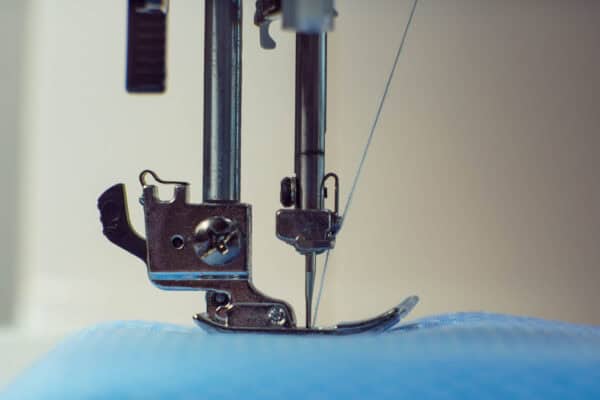
Not every problem can be solved simply by using a thicker needle.
Proceed step by step:
1. Stop the machine.
2. Check that the needle is suitable for the fabric.
3. If in doubt, insert a new needle.
4. Check the thread tension and threading.
5. Reduce the sewing speed.
6. Use the handwheel in certain areas.
7. Compensate for the height difference behind the presser foot.
8. Reduce unnecessary layers of fabric or interfacing.
9. Use a slightly longer stitch length.
10. Check whether the fabric combination exceeds your machine’s limits.
Never force the machine to continue sewing if it is jammed. Doing so may damage the needle, needle plate, looper, or needle holder.
Choosing the right sewing machine needle is a small but crucial part of your bag-making project.
For regular cotton fabrics, a size 80 all-purpose needle is often sufficient. For canvas, denim, webbing, and thicker layers, a size 90 or 100 denim needle is often the better choice. A Microtex needle can be helpful for coated, smooth, and tightly woven materials, as well as for precise seams. You should use leather needles specifically for genuine leather and suitable, sturdy imitation leather.
The key factor is always the overall combination of fabric, batting, thread, number of layers, and sewing machine.
If your machine suddenly skips stitches, makes a clattering noise, or breaks the thread, start with the simplest solution: Insert a new needle that’s suitable for the fabric.
This small change can make a surprisingly big difference.
For a simple bag made of regular woven cotton fabric, a size 80 all-purpose needle is usually sufficient. If you’re working with stiff interfacing, multiple seam allowances, or thicker handles, a size 90 all-purpose or denim needle may work better. Test the entire fabric combination on a scrap piece before sewing.
For canvas, a size 90 denim needle is a good starting point. For heavy-duty canvas, webbing, thick seams, or multiple reinforced layers, a size 100 denim needle may be necessary. The reinforced shank of a denim needle is designed for tightly woven and thick materials.
For soft faux leather, a Microtex or universal needle in sizes 80 to 90 is often suitable, depending on the construction. If there are multiple layers, a denim needle may also work. For very stiff faux leather, a leather needle may be necessary. Always test on a scrap piece first, as needle holes in synthetic leather remain permanently visible.
Missed stitches can be caused by a dull, bent, incorrectly inserted, or unsuitable needle. Other possible causes include incorrect threading, an incompatible combination of thread and needle, difficult fabric layers, or a machine that isn’t set up correctly. First, insert a new, appropriate needle, rethread the machine completely, and test the seam on a scrap piece of fabric.